A FORTRESS FULL OF STORIES
Your story is next
Fortress Vuren is not just a location. It is a place where history breathes through every stone
and where your story becomes part of something much bigger.
Discover more
Est. 1844–1848 · UNESCO World Heritage
UNESCO
WORLD HERITAGE
495
WARTIME GARRISON
200 KM
WATERLINE LENGHT
1845
YEAR BUILT
Recognised as a
World Heritage Site
Unique in the world
Maximum soldiers stationed here during full military mobilisation
A chain of forts and
flood zones from Edam
to the Biesbosch
Constructed 1844–1848
as part of the
New Dutch Waterline
CONTEXT
PART OF SOMETING
much bigger
Fort Vuren does not stand alone. It is one of five extraordinary locations that form the Vestingdriehoek — the Fortress Triangle — where the rivers Waal, Maas and Merwede meet across three Dutch provinces.
The triangle connects the fortified cities of Gorinchem and Woudrichem, the medieval Slot Loevestein castle, the walled city of Zaltbommel, and Fort Vuren itself. Together they represent 600 years of history, three rivers, and one of the best-preserved defensive landscapes anywhere in the world.
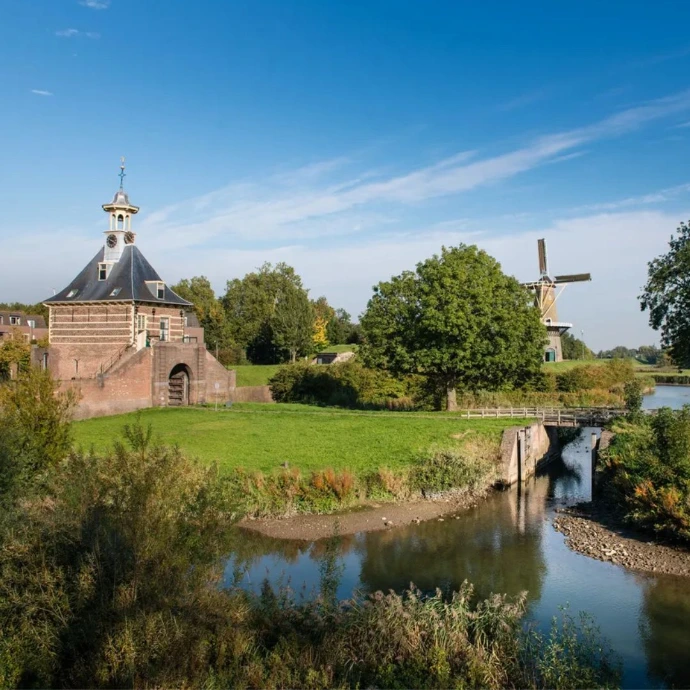
The Fort and Slot Loevestein, directly across the river Waal from each other, could deliver cross-fire to halt any enemy ship attempting to pass. Two monuments, one river, one extraordinary view — still visible from the island today.
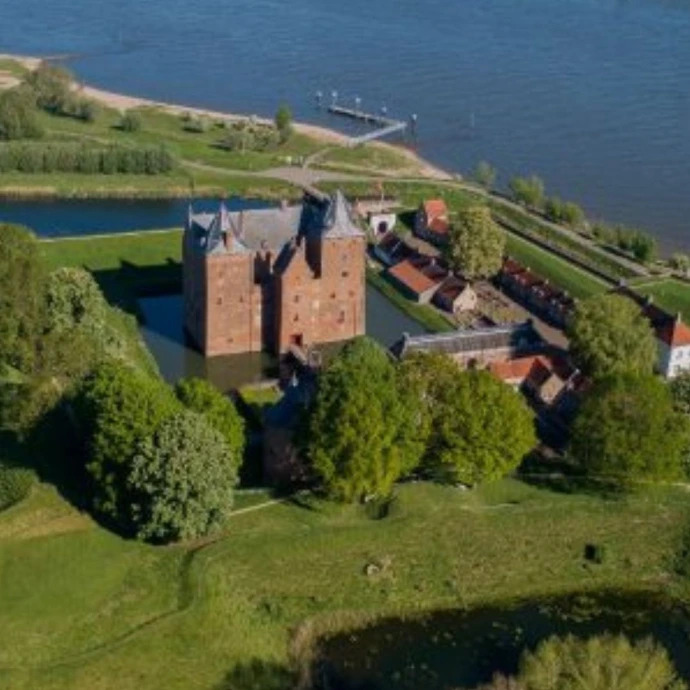
Fort Loevestein
The medieval castle directly across the Waal from the island — visible from your window on a clear morning. Built in 1357, later a state prison, famous for the dramatic escape of Hugo de Groot in 1621. Five minutes by ferry. A thousand years of stories.
DE VESTINGDRIEHOEK
Five fortified places. Three rivers. Six hundred years The medieval castle directly across the Waal from the island — visible from your window on a clear morning. Built in 1357, later a state prison, famous for the dramatic escape of Hugo de Groot in 1621. Five minutes by ferry. A thousand years of stories.of history in one extraordinary corner of the Netherlands. Gorinchem, Woudrichem, Zaltbommel, Slot Loevestein and Fort Vuren — all connected by ferry. All within cycling distance. All worth a day of your life.
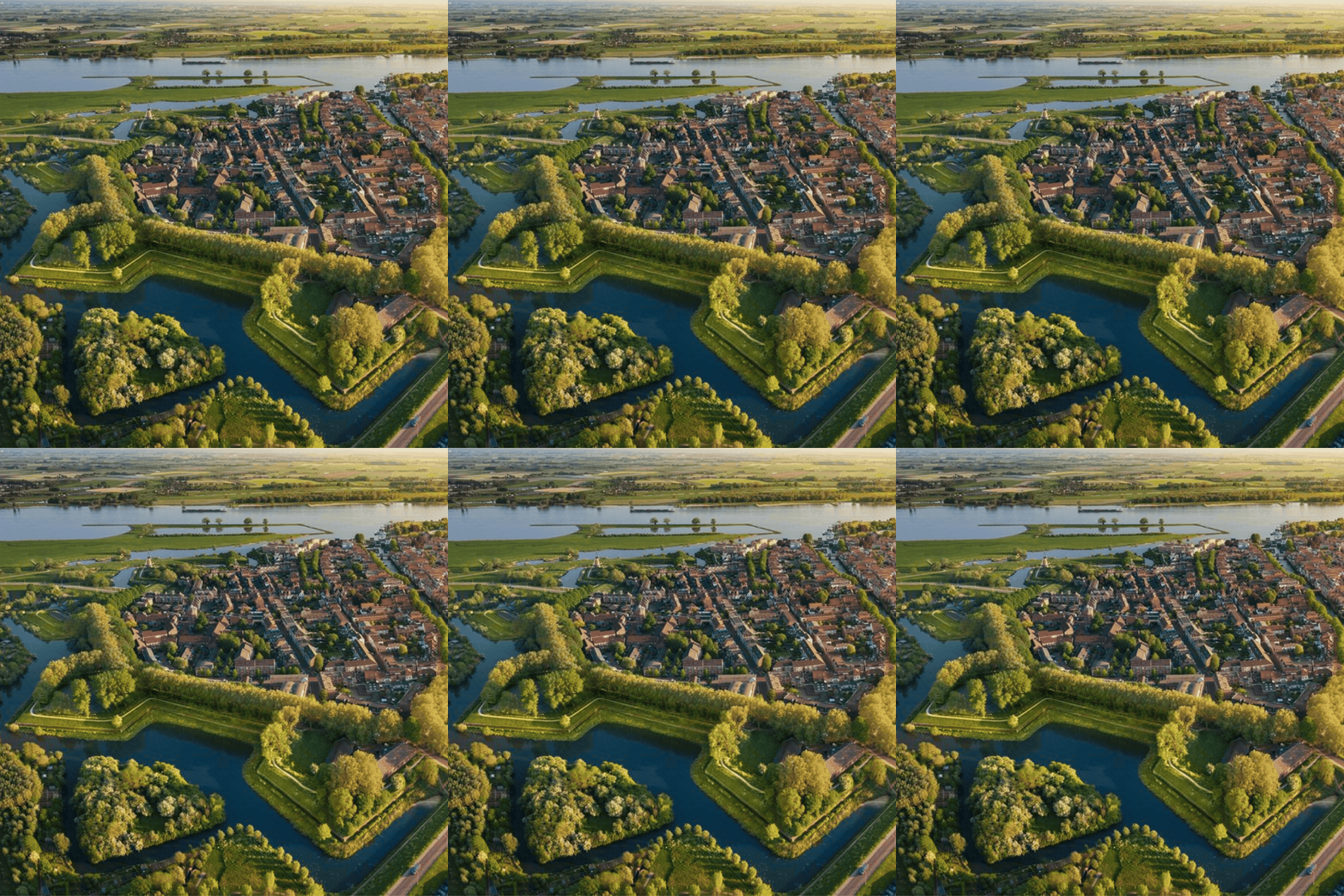
GORINCHEM
The largest intact fortified city in the Netherlands, twenty minutes from the island by car or ferry. Ramparts you can walk, a historic centre worth getting lost in, and the best starting point for exploring the Vestingdriehoek by bike and boat.
180 YEARS IN THE MAKING
The history
1844–1848
An island is born
Fort Vuren — officially "Fort bij Vuren" — is an island in the river Waal, built between 1844 and 1848. Surrounded by water on all sides, it was built as a strategic stronghold in one of history's most ingenious defensive systems.
The fort forms part of the New Dutch Waterline: a 200-kilometre network of over 60 fortifications stretching from Muiden in the north to the Biesbosch in the south. Fort Vuren covers seven hectares and was designed together with the medieval Slot Loevestein directly across the river — the two could deliver cross-fire to halt any enemy ship on the Waal.


THE NEW DUTCH WATERLINE
Water as a weapon
The principle was brilliantly simple. By flooding strips of land between one and five kilometres wide — too deep for men and horses, too shallow for boats — the Dutch turned their flat landscape into an almost impenetrable barrier.
Fort Vuren guarded the critical river crossing at the Waal, together with the medieval Slot Loevestein on the opposite bank — blocking any enemy advance towards Gorinchem.
BUILT TO LAST
Walls that could
stop a cannon
The fort's walls range from 1.20 to 3.20 metres thick — entirely bombproof by the standards of the day. Access was via a unique swing bridge, the kraanbrug, making the island genuinely unreachable to anyone not invited.
As weapons technology advanced, a curved contrescarp gallery was added around the tower, providing additional fortification along the eastern flank. Every stone has a purpose.


1945–1948
Liberation & then peace
When the war ended, the Netherlands found its feet again — and Fort Vuren played one last official role before its military chapter closed for good. By 1948, the island was ready to step out of uniform and into something entirely new.
A century of service — defensive, military, historic — came to a quiet end. The fort had done its duty. Now it was time to simply be.
1948–2012
The island waits
With its military purpose complete, Fort Vuren was handed into the careful stewardship of Staatsbosbeheer — the Dutch Forestry Commission. The island was protected, preserved, and left to breathe. Nature moved in around the edges. The Waal kept flowing past.
The vaulted ceilings, the iron doors, the thick stone walls: all exactly where they had always been. Patient. The island had been many things — a fortress, a garrison, a monument. Now it was simply resting. Waiting for its next story.


2012-2018
The great restauration
Between 2012 and 2018, Fort Vuren underwent a monumental six-year restoration. The fort was literally excavated, fully restored from the foundations up, fitted with a waterproof protective layer and carefully re-covered with earth — exactly as the original builders intended it to look.
New walking routes were laid around the island. The historic Fortwachterij — the gatehouse — was rebuilt. Under the care of Staatsbosbeheer and the Stichting Wandel- en Fietsforten, the fort was declared fit for the next fifty years. The island was ready to live again.
2021
Unesco official
In 2021, the Dutch Water Defence Lines — including Fort Vuren — were inscribed on the UNESCO World Heritage List, recognised alongside the Stelling van Amsterdam. The designation confirmed what those who know the island already knew: this is one of the most remarkable pieces of military heritage in the world.
Fort Vuren is part of the largest national monument in the Netherlands: a 200-kilometre chain of over 60 fortifications. The UNESCO listing brought new visitors, new attention, and a new chapter.


2023-NOW
A new fire is lit
Between 2012 and 2018, Fort Vuren underwent a monumental six-year restoration. The fort was literally excavated, fully restored from the foundations up, fitted with a waterproof protective layer and carefully re-covered with earth — exactly as the original builders intended it to look.
New walking routes were laid around the island. The historic Fortwachterij — the gatehouse — was rebuilt. Under the care of Staatsbosbeheer and the Stichting Wandel- en Fietsforten, the fort was declared fit for the next fifty years. The island was ready to live again.
RECOGNIZED BY UNESCO
Fortress Vuren forms part of the Dutch Water Defence Lines — a UNESCO World Heritage Site, recognised alongside the Stelling van Amsterdam. The designation honours a uniquely Dutch achievement: engineering water itself as a defensive weapon, on a scale found nowhere else in the world.
Of all the forts in this network, Fort Vuren stands apart. It is one of the very few you can not just visit — but truly inhabit. Sleep here. Celebrate here. Feel 180 years of history beneath your feet.
A real island. A real story.
WORLD HERITAGE
Today
A FORTRESS THAT TELLS
your story
Today, Fortress Vuren has been transformed — carefully, without losing a single stone of its character. The vaulted brick ceilings, the iron doors, the moat, the tower: all still here. All still unmistakably a fort.
Guided tours, a Petit Musée and a mini-theatre keep the history vivid and tangible. But the island has also become something new: a destination for people who want their most important celebrations to happen somewhere that actually means something.
When you hold your wedding here, you are not just renting a venue. You are becoming part of a story that started in 1845 — and continues, remarkably, with you.